Mold Removal in Fishtown, PA
Fishtown runs along the Delaware from the Girard Avenue bridge approaches up past Penn Treaty Park, and its brick rowhouses are among the oldest in the city, many from the 1850s through the 1890s, with two-story workers' rows on the side streets and three-story houses along Frankford Avenue. Since about 2010 the blocks have filled in with new three- and four-story construction, roof decks, and factory conversions, so a new build often shares a party wall with a house that is 150 years old.
A call from Fishtown goes to an independent local mold provider who reads the house with a meter before saying what comes out. We connect the call; the provider does the rest.
That pairing is Fishtown's mold pattern. The old house has a rubble foundation and a flat roof that drains to one box; the new one has a roof deck whose scuppers clog and a stucco or fiber-cement wall that was flashed in a hurry. Water from either side shows up on the shared brick. Fishtown is also on the combined sewer, and the low blocks toward the river see floor drains back up in a hard storm.
Fishtown mold removal where an 1860s row meets a 2019 build
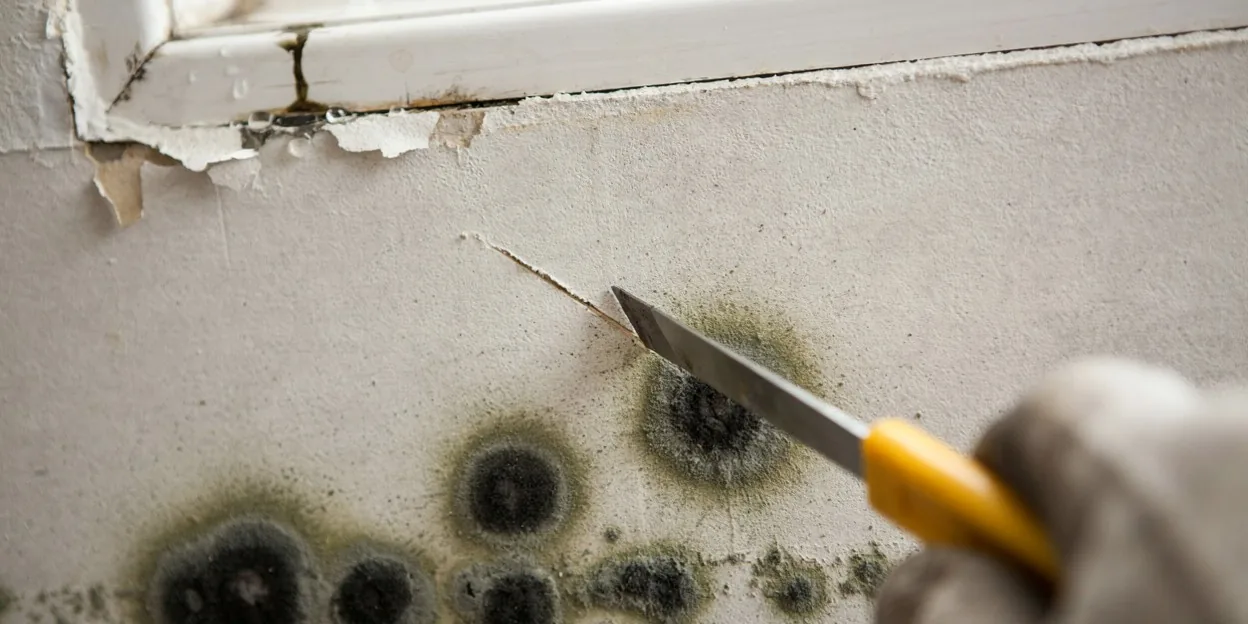
A stain and soft plaster on the party wall is mold removal, and the crew asks to see the neighbor's roof. A roof-deck leak that ran down inside a new build's wall cavity is also mold removal, with the drywall opened to the meter line. A basement that took sewer water is whole-home mold remediation if it reached the first floor.
The neighborhood association and the river that named the place
The Fishtown Neighbors Association tracks zoning and new construction block by block, which matters when the leak on your side of the wall started with a project on the other side.
Call (215) 600-0376 and tell us what you see. We put you through to a local mold provider serving Fishtown.
Services Available in Fishtown
Mold Removal
Growth on plaster or drywall after a party-wall leak, a stone-foundation seep, or a radiator pipe: room sealed, wet material cut to the meter line, framing HEPA-cleaned and dried.
Black Mold Removal
A dark patch on a basement wall or bathroom ceiling handled by how far the water traveled, not its color: containment, porous material out, hard surfaces cleaned, source fixed.
Whole-Home Mold Remediation
A sewer backup that filled the basement or a flat-roof leak that ran down three floors, mapped floor by floor and cleared in zones as one project.
HVAC Mold Cleaning
Coil, drain pan, and condensate line cleaned or replaced when a basement or closet air handler sweats through a humid Philadelphia summer.
Bathroom Mold Removal
Growth behind a vanity, under a tile shower, or on a ceiling with no exhaust fan in a rowhouse second-floor bath, removed with the leak fixed first.
Attic Mold Remediation
Growth on rafters and sheathing under a flat roof or a twin's slate roof, cleaned and treated once the roofing or the ventilation is corrected.
Mold Odor Removal
A musty smell in a rowhouse that looks fine, traced to a wet stone wall, a damp joist end, or the dirt under an old cellar floor, then removed and treated.
Mold Damage Repair
Plaster, drywall, baseboard, and subfloor put back after removal, once the basement reads dry and the roof, pipe, or drain that caused it is repaired.